NOTE - menu items are added when I create a post - if a link doesn't work, it may be a scheduled post that
What can I make when I start with an 11" x 4 1/4" strip of cardstock?
I won't show the basic "fold it in half" card. Neither will I list everything that can be done in the same way as a standard 5 1/2" x 8 1/2", though I'll certainly add those if I make some. This page, however, focuses on other possibilities.
Be sure to check back periodically because I don't have examples yet for
all of them, and I'll continue to add additional structures. You'll see I've arranged this Fun Fold section differently than the other two fun fold lists (Fun Folds from 5 1/2 x 8 1/2, and Other Fun Folds). I thought it would be interesting to list by activity required - to see if that might inspire even more fun folds!
Apertures
This would be any shape cut from the card front itself that does not cut any part of the edge.
Cutaways
Here
we have a variety of ways that parts of the front panel can be cut away
to let parts of the inside of the card show to the outside.
- Barn Door:
%20-%2020250425.JPG)
You can see the above card here
for details, but basic instructions are as follows. Score and fold at 5
1/2" as normal. With card in horizontal position, cut off top 1 1/2"
of card front.
.JPG)
.JPG)
For
the finished card you see above, I simply added a circular sentiment to
the upper portion of the "bard door". But, I could have put the
circular element on the inside of the card and used a punch to cut out
1/2 circle from top edge of remaining card front so it showed through.
Other Examples:
- Faux Cutaway:
.JPG)
See original here. Score at 1 3/4" and 7 1/4" and fold as valley folds and orient with small flap at the bottom - glue small flap closed.
Other Examples:
- Cut, Turn, Paste - Horizontal:
.JPG)
For this one, I simply scored and folded it at 5 1/2 as usual. Then, cut the card front in half at 2 3/4". I turned the cut off piece and glued it to the card front as you see here:
.JPG)
Other Examples: Hot Foiled Magic,
- Cut, Turn, Paste - Vertical:
Same as above - except turned vertically.
- Cutaway Gate Fold:

I started this card
by cutting off a piece that is 2 3/4" x 4 1/4" just like the last card,
but then it is scored and folded differently. Looking at the sketch
below, cut on solid line (2 3/4" x 4 1/4" piece). Score on dotted lines
(1 3/8" from each edge).

Fold
and crease the scored lines. Decorate as you wish, then turn the cut
off panel sideways, center it on the card, and glue just to the left
side.
- Gap card - Cut-Turn-Gap:
%20-%2020250425.JPG)
Though this
looks similar to the last one, it isn't. The far right side is not
attached to the inside of the card. In it's simplest terms, a gap card
is created by cutting away part of the card front BUT adding something
to "bridge the gap" and thus hold the card together.. You can use a
variety of things to "bridge the gap" - including die cut words or other
shapes - even acetate. For this card, I simply turned the center piece that was cut
off and use it to bridge the gap.
.JPG)
.JPG)
.JPG)
Similar to the basic gap card, this one uses acetate to bridge the gap with or without various other die cuts across the gap.
Other Examples:
Slice It
Instead of cutting part of the card away, these cards have slices in various places to create different card structures
- Split Face Pocket Gift Card Holder:
.JPG)
Here
for the base card we have simply folded the cardstock in half to create
an A2 sized card, and then cut a slice through the card front at 1 1/2"
from the edge.
.JPG)
Decorate
as you desire and glue the short/narrow piece to the inside of the card
on just 3 sides creating a pocket that holds the gift card:
.JPG)
Multiple Folds
Now we come to cards with two or more folds.
- Accordion - Fancy 1:
This time I scored the card at 2 3/4", 5", 6", 8" and 9".First two are valley folds, then mountain, valley, mountain. Crease all well.
.JPG)
.JPG)

.JPG)
Create
a focal with base of 3 7/8" x 4 1/8". This, when glued to the card
front, will extend another 1 1/4" to the left, creating a standard A2
sized card. On the right side, after all is decorated, consider adding a
decoration on dimensionals that can serve as a "latch" to hold the card
closed.
- Double Fold-Back or Fancy Accordion style 2:
.JPG)
.JPG)
This time I made multiple score/fold lines at 2 3/4", 4 1/4", 7 1/4", and 8 1/2" - then folded as mountain, valley, mountain, valley:
.JPG)
I made a 4 x 4 focal panel and glue it just to the front folded piece - extending it past the fold. Then decorate the other panels:
.JPG)
More Examples: More Fold-Backs,
- Bay Window:
You can easily create
an A2 sized card by scoring the 4 1/4" x 11" card at 5 1/2", 6", 7 1/2",
9", 10 1/2". First is a mountain fold, then valley, then 2 more
mountain folds and another valley so you card base looks like this:
.JPG)
- Book:
.JPG)
This card is pretty simple - score at 5 1/2" and at 6 1/2" - first a
mountain fold, then a valley fold. Glue card shut between the two
folds.
.JPG)
Other Examples:
- Book with Fold Back:
Similar to the last one, this card adds an additional score line at 8 3/4" that is folded back:
.JPG)
- Matchbook:
%20-%2020250426%20(1).JPG)
This pretty otter card
again started with a 4 1/4" x 11" strip of white card stock. This time I
scored it at 4 3/4", 9 1/2" and 10". I folded the first and last score
line as valley folds and creased well, then I gently folded back along
the other score line making a bit of a mountain fold, but not with a
strong crease - just enough to make the card easier to use. The I
stapled near the bottom of the 1" fold to hold it in place, making sure
the "clean" line of the staple was at the back since the front side
would be covered.
.JPG)
%20-%2020250426%20(2).JPG)
- Easel:
.JPG)
.JPG)
This one is a basic easel card - 4 1/4" x 11" - scored at 5 1/2" and 2 3/4", with a patterned paper "stopper" added with Mini Stampin' Dimensionals.
- Vertical Easel:
.JPG)
.JPG)
Made like the previous easel - except rotated 90 degrees with the stopper near the edge of the card. The trick with this one is the hinge pieces behind the focal.
- Fold Back - Partial:
.JPG)
For this card
you again fold it in the middle to create an A2 sized card - but then
score the front of the card 1 1/2" from the right edge and fold it back
as you see in the picture below:
.JPG)
Create
a square panel (usually do a 4 x 4, but this time did a 3 3/4 x 3 3/4)
and glue it to just the folded back piece. Add a panel to the right
side of the inside so it shows through to the front when closed. Here's
what it looks like when partially open:
.JPG)
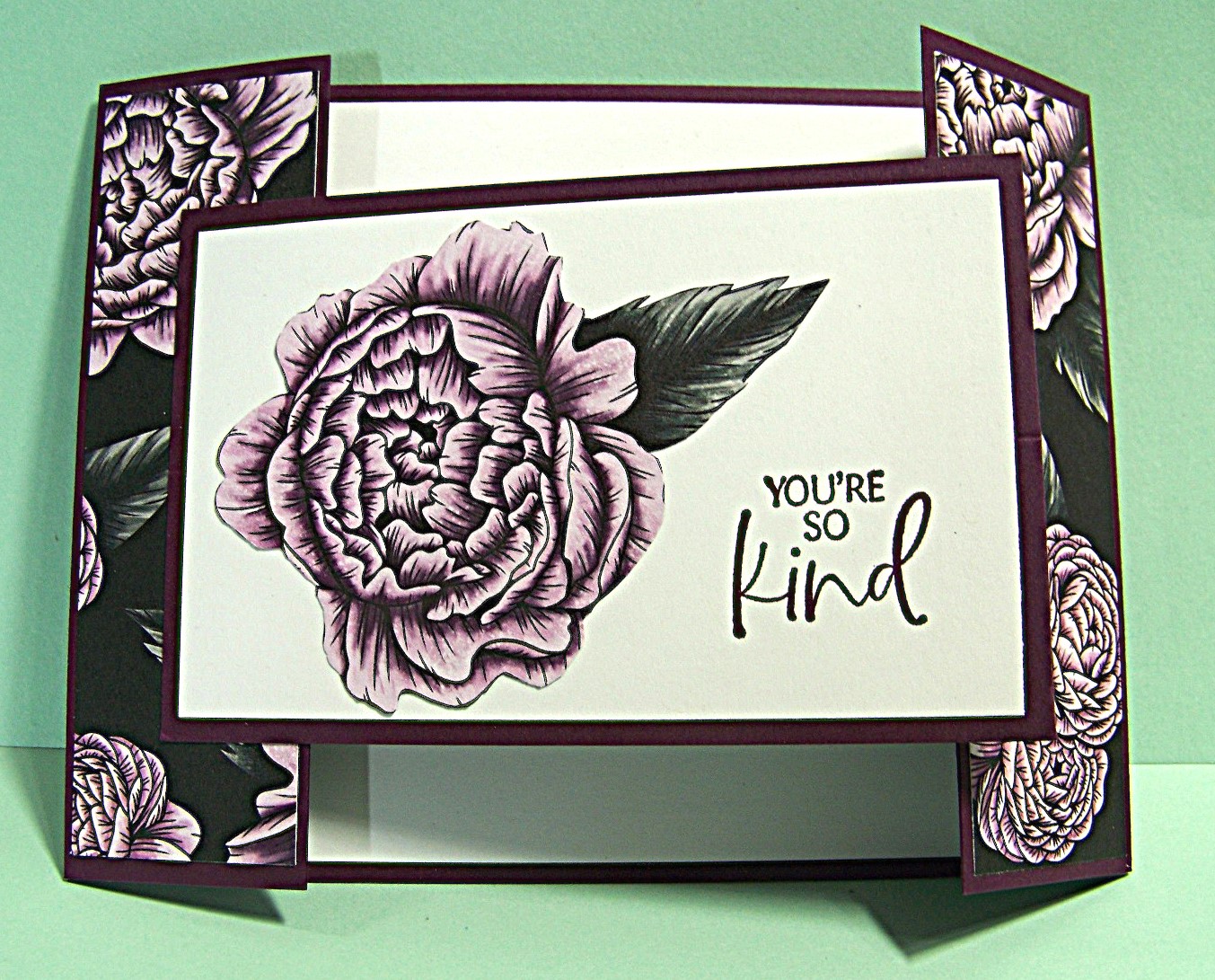
- Gate Fold:
%20-%2020250425.JPG) This card is simply scored at 2 3/4" from each end, with the ends then folded to meet in the middle.
This card is simply scored at 2 3/4" from each end, with the ends then folded to meet in the middle..JPG)
%20-%2020250425.JPG)
.JPG)
- Pop Out - Diamond Center: (July 3, 2011)
- Pop-Through Circle with Latch:
It looks trickier than it really is. This time you score at 4 1/4" and 8 3/4". Before folding use a punch or cutting die to cut out 2" circle center over 8 3/4" score line toward the right side.Then valley fold along both score lines. After adding your decorative papers to both the card and the circle you removed, you will close the card as shown in the finished picture and glue the lower part of the circle to the card through the indentation that was cut out. After the glue has dried, you can open this card by threading the added circle back through the punched/die cut circular hole. In this case, I also added a bee on foam tape to the lower part of the card so it could serve as a latch to help hold the flap closed.
.JPG)
This example is made basically the same, but the dimensions are slightly different.
Other Examples:
Slice It WITH Multiple Folds
These cards have slices in various places along with multiple folds to create the structure.
- Inverted Center Step card:
.JPG)
This one is made basically the same way as the other Inverted Center Step cards - simply a vertical version.
No comments:
Post a Comment